Condo Vinyl Flooring Built Around Your Sound Rules
Waterproof vinyl plank with an underlayment matched to what your association requires. For condos and HOA communities from Tampa Bay to Orlando, including Sarasota, Sun City Center and The Villages.
About $5 to $12 per square foot installed, before your discount. The exact number comes after a free measurement.
50% off your flooring installation$1,200 Off + 5% Senior & Military Savings Claim →Free Measurement in 60 Seconds
Answer 5 quick questions. No cost, no obligation.
What floor are you replacing?
Your neighbor downstairs hears your floor
In a house, the floor only has to please you. In a condo, it also has to keep footsteps, chair legs and dropped pans from ringing through the ceiling below. That’s why most associations have flooring rules, and why the underlayment matters as much as the plank.
- Florida has a minimum. The Florida Building Code sets a sound rating of 50 for the floor-ceiling assembly between units, for both impact noise (IIC) and airborne noise (STC).
- Many associations ask for more. It’s common for condo boards to require ratings in the 55 to 60 range. Your association’s rules decide the number, not us.
- The rating is for the whole assembly. Plank, underlayment, the concrete slab and the ceiling below all count together. A plank’s own label doesn’t settle it.
- The underlayment is matched to your rules. Bring your association’s flooring requirements to the measurement. The installer picks an underlayment rated for what they ask.
50% off your flooring installation
$1,200 Off + 5% Senior & Military Savings. Seniors 60+ and active or retired military get an additional 5%. The 50% applies to installation labor.
See rep for details! Mention offer during your design consultation.
IIC and STC in Plain Terms
Two ratings show up on nearly every condo flooring form. Higher numbers mean less sound gets through.
Impact noise
Footsteps, heels, a dropped spoon, a chair pushed back. This is the one your downstairs neighbor notices most.
Airborne noise
Voices, the TV and music traveling through the floor and ceiling.
Above the code minimum
Florida code sets 50. Many associations set their own higher number. Check your documents.
Unsure what your building requires? Ask your property manager for the flooring section of the rules before you book.
From Condo Rules to a Quiet New Floor
The steps are the same as any install, with a little paperwork up front.
Get your rules
Find the flooring section of your association documents, or ask the property manager. Note the required ratings and any approval form.
Measure and match
An installer measures the unit, looks at the slab and picks a plank and underlayment rated for your association’s numbers.
Board paperwork
You’ll get the product and underlayment information to include with your approval request. You submit it and wait for the board’s answer.
Schedule around the building
Tell us your building’s work hours and elevator rules when you book, so install day fits inside them.
Install and clean up
Old flooring out, underlayment and planks down, trim back on, debris hauled away. Most installs are completed in a single day once your materials arrive.
What Condo Vinyl Flooring Costs
Most jobs run about $5 to $12 per square foot installed, before your discount. A higher-rated sound underlayment sits toward the upper end. Slide to your square footage.
A 12 × 16 bedroom is about 200 sq ft.
Wear layer, room shape and the floor underneath all move the number inside this range.
Estimates only, not a quote. Your price depends on your rooms, the product you pick and the floor underneath, and is set after the in-home measurement.
What adds to a condo job
- A higher-rated sound underlayment
- Tile removal on an upper floor
- Tight building work hours
- Many small rooms and closets
What helps
- Knowing your required ratings before the measurement
- Open living and dining areas
- A flat slab
- The 50% off installation labor offer
Financing: low monthly payments, 0% interest plans, and same-as-cash offers (for qualified applicants).
Quiet, Easy to Clean and Easier on the Knees
The same floor that keeps the neighbors happy is also a good floor to live on every day.
A textured surface
Embossed planks have more grip than smooth tile, wet or dry. Is vinyl plank slippery for older adults
Softer than tile
The pad and underlayment give a little underfoot. Standing in the kitchen is easier on knees and hips than it is on ceramic.
No grout to scrub
A damp microfiber mop is all it needs. No sealing, no grout lines turning grey.
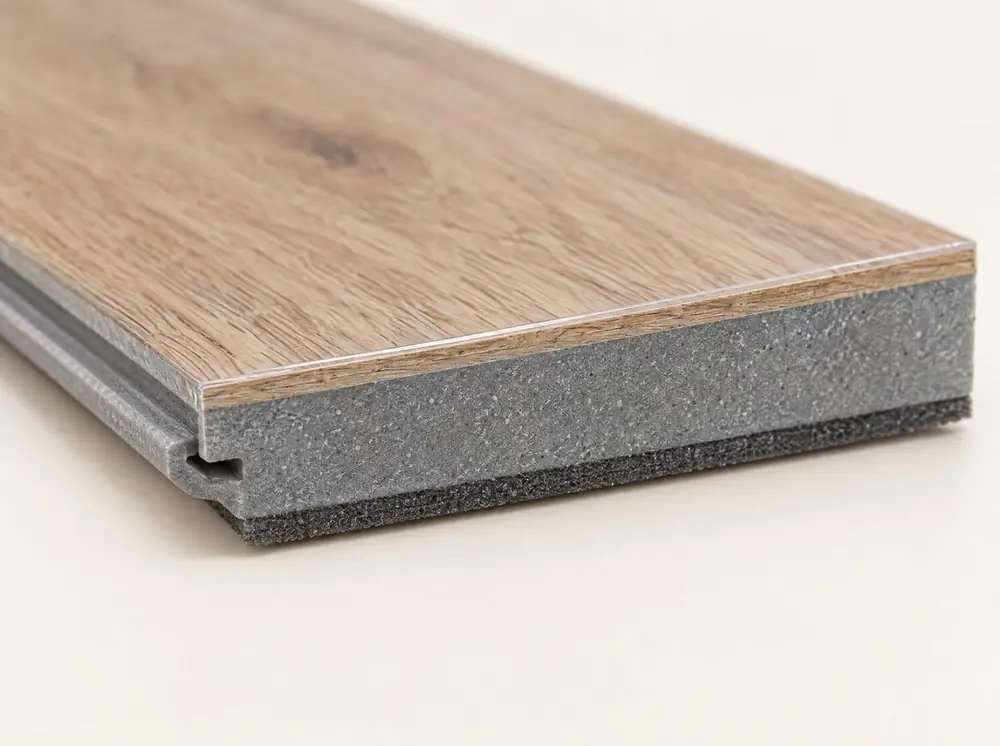
What’s Inside a Plank
In a condo, a sound-rated underlayment goes under the plank shown here.
 12
34
12
34
- Wear layer. Up to 20 mil for busy rooms.
- Printed wood look. Grain and color, sealed in.
- SPC core. Waterproof and rigid.
- Attached pad. Plus the rated underlayment your rules call for.
Lab Ratings, Field Ratings and What Your Board Reads
The Florida Building Code gives two ways to show a floor-ceiling assembly meets its sound minimum between units. One is a lab test. The other is a test done in the building. Knowing which one your rules ask for saves a round of paperwork.
| Rating | What it measures | Test method | Florida Building Code minimum |
|---|---|---|---|
| IIC | Impact noise, in a lab | ASTM E492 | 50 |
| AIIC | Impact noise, tested in the building | ASTM E1007 | 45 |
| STC | Airborne noise, in a lab | ASTM E90 | 50 |
| NNIC | Airborne noise, tested in the building | ASTM E336 | 45 |
What the code sets
- A floor between units rated at least 50 in the lab, or 45 when field tested
- The same floor for impact and airborne noise
- A minimum, not a target
What your association can add
- A higher number, often 55 to 60
- A lab rating, a field test, or both
- An approval form, and a wait for the board’s answer
- Work hours and elevator rules for install day
Board approval is between you and your association. We can’t promise any board will approve a floor. What you will get is the product and underlayment information to submit with your request.
Plank and Underlayment for a Condo
In a condo, the spec sheet matters as much as the color. Three things to read before you choose.
Read the test conditions
One 20-mil rigid plank lists IIC 54 and STC 51, tested over a 6-inch concrete slab. That’s a lab number for that assembly. Your building’s slab and the ceiling below may not match it.
What the floor adds
The same sheet lists a delta IIC of 23, under ASTM E2179. It measures how much the flooring itself cuts impact noise over the bare slab, so it compares products, not buildings.
More isn’t quieter
One maker allows a second underlayment under plank with an attached pad only up to 3 mm, and says its lab tests haven’t shown extra sound benefit from it. It also rules out crumb rubber underlayment.
One maker also warns that soft layers underneath compromise the plank’s locking joints. The right tested assembly beats extra padding. The installer matches the underlayment to your association’s numbers at the measurement.
Where Sound Rules Bite Hardest
Every room over a neighbor counts. Some rooms get more attention than others.
Living and dining areas
The most footsteps and the most chair legs. Usually the biggest open area in the unit.
Kitchen and baths
Dropped pans and running water. If plank is replacing tile in these rooms, check that your rules cover them the same way as the living area.
Bedrooms and closets
Coming from carpet, a hard floor carries more footstep noise. The rated underlayment matters here as much as anywhere in the unit.
Doing the whole unit at once keeps one plank, one underlayment and one set of paperwork for the board. It also means one plan for the doorways, instead of a mix of floor heights from room to room.
Before install day in a condo
A condo install has a few more moving parts than a house. Most of them are handled before the crew arrives.
- Get the written approval. Have the board’s answer in hand before install day is set.
- Reserve the elevator. If the building has a service elevator, ask how to book it for install day.
- Check work hours. Know the start time, the quiet hours and whether weekend work is allowed.
- Arrange parking. Ask the manager where a work truck can load and unload.
- Ask about debris. Find out where the building wants old flooring carried out, and whether the building dumpster is off limits to contractors.
- Give the neighbor below a heads-up. Tear-out is the loud part of the day.
- Clear the unit. Small furniture, rugs and everything on closet floors.
- Leave the AC on. Plank goes down best in a cool, steady unit, even if you’re leaving for the season after.
Before You Talk to Your Board
Answers to what condo owners ask us most.
Condo Flooring Questions
Will vinyl plank meet my condo’s sound rules?
It can, with the right underlayment. The rating depends on the whole floor-ceiling assembly, so the installer matches the underlayment to the numbers in your association’s rules. Final approval is your board’s decision.
What IIC rating do Florida condos require?
The Florida Building Code minimum is 50 for both IIC and STC between units. Many associations require more, often 55 to 60. Your association documents have the number that applies to you.
Do I need board approval before install?
Most associations require it. You submit the request. You’ll get the product and underlayment information the board asks for to include with it.
Floating or glue-down in a condo?
Either can work. Some associations specify one or the other, and some sound-rated underlayments are made for a specific method. The installer follows your rules.
Can the install fit our building’s work hours?
Tell us the hours and elevator rules when you book. Most installs are completed in a single day once your materials arrive.
I’m away for the summer. Is that a problem for the floor?
Keep the AC running at a steady temperature while you’re gone. Vinyl plank doesn’t like big swings in heat. Our seasonal guide covers the settings.
What’s the warranty?
Installations come with our Limited Lifetime Warranty. It isn’t transferable if you sell the unit. The flooring also carries the manufacturer’s warranty.
What’s the difference between IIC and AIIC?
IIC is measured in a lab under ASTM E492. AIIC is measured in a real building under ASTM E1007. The Florida Building Code accepts 50 for the lab rating or 45 for the field test. Your association’s rules say which one they want and what number.
Will a thicker underlayment make my floor quieter?
Not necessarily. One maker says its lab tests haven’t shown extra sound benefit from a second underlayment under plank with an attached pad, and caps that second layer at 3 mm. The right tested underlayment matters more than thickness.
Does a plank’s sound rating on the box guarantee I’ll pass?
No. Box and spec sheet numbers come from a lab test of one assembly, often over a 6-inch concrete slab. Your building’s slab and ceiling are different. The rating that counts is the one your rules call for, and approval is the board’s decision.
Should I tell my downstairs neighbor?
It’s a good idea. Tear-out is the loud part of the day. A note with the date and the building’s work hours goes a long way in a building where you’ll live next to each other for years.
Floating or glue-down if the unit sits closed for months?
One maker’s rigid core guide allows its floating floors in spaces left without climate control for part of the year, within a wide temperature range, and says that allowance doesn’t apply to glue-down. If your association lets you choose, that’s worth weighing. In Florida humidity, leaving the AC on is still the safer habit.
My neighbor’s floor was approved. Can I use the same one?
It’s a good place to start, and it tells you what the board has accepted before. Your request is still reviewed on its own, and the rules may have changed since. Ask your manager, and bring the same spec sheets your neighbor used.
Condo Flooring Near You
Condos and HOA communities across Tampa Bay, the Gulf Coast and Greater Orlando.
Other Jobs We Handle
Ready for a Floor That Can Take a Spill?
Book your free in-home measurement. Phones are answered 9:00 AM – 5:00 PM.