Water-Damaged Floor Replacement With a Floor That Won’t Swell
When a pipe, a water heater or a storm ruins your floor, we put back waterproof vinyl plank on an SPC core. We handle the rebuild once the area is dry, from Tampa Bay to Orlando.
About $5 to $12 per square foot installed, before your discount. The exact number comes after a free measurement.
50% off your flooring installation$1,200 Off + 5% Senior & Military Savings Claim →Free Measurement in 60 Seconds
Water-damaged floor selected. Four more quick questions.
How many rooms?
We rebuild the floor after the water is gone
Water damage happens in two stages. First the water has to come out and the house has to dry. Then the ruined flooring gets replaced. We do the second part.
- We are not an emergency water removal company. If there is still standing water, wet drywall or a running leak, call a plumber and a water mitigation company first. They pump, dry and document the damage.
- Call us once it’s dry. An installer measures the rooms, checks the slab and tells you what has to come out before the new floor goes down.
- You get a floor that can take the next leak. The SPC core doesn’t soak up water, so a burst supply line next year means a cleanup, not another tear-out.
- The paperwork helps with your claim. Your written estimate lists the rooms and square footage. You can share it with your insurance adjuster.
50% off your flooring installation
$1,200 Off + 5% Senior & Military Savings. Seniors 60+ and active or retired military get an additional 5%. The 50% applies to installation labor.
See rep for details! Mention offer during your design consultation.
Why the Old Floor Didn’t Survive
Most water-damaged floors we replace were carpet or laminate. Both hold water in places you can’t reach with a towel.
Soaks through
The pad under it acts like a sponge. Once it’s wet for days, it usually has to go, along with the tack strip.
Swells at the seams
The core is pressed wood fiber. When water gets into the edges, the boards puff up and stay that way.
Waterproof core
Stone plastic composite doesn’t absorb water. Spills and leaks stay on top where you can wipe them.
Comparing options? Read: Vinyl plank vs laminate in Florida humidity
How a Water-Damage Floor Job Goes
From a dry room to a floor you can walk on.
Confirm it’s dry
We ask whether a mitigation company has signed off on the drying. If you’re not sure, we check the slab for moisture before anything else.
Measure every wet room
Water travels under walls and cabinets. The installer measures each affected room and marks where the damage stops.
Damaged material out
Leftover pad, tack strip, swollen laminate and ruined baseboards come up and leave with us.
New floor down
Waterproof planks go down across the rooms, with matching transitions at the doorways so the old and new areas meet cleanly.
Trim back on
New baseboards or quarter round finish the edges. You’re back in the room the same day the floor goes in.
Most installs are completed in a single day once your materials arrive. Next-day installation is available.
What Water-Damaged Floor Replacement Costs
The new floor itself runs about $5 to $12 per square foot installed, before your discount. What varies is how much damaged material has to come out first. Slide to your square footage.
A 12 × 16 bedroom is about 200 sq ft.
Wear layer, room shape and the floor underneath all move the number inside this range.
Estimates only, not a quote. Your price depends on your rooms, the product you pick and the floor underneath, and is set after the in-home measurement.
What adds to the job
- Removing wet pad, tack strip or swollen laminate
- Replacing ruined baseboards
- Water that reached several rooms
- Low spots in the slab that need filling
What helps
- Old flooring already pulled by the mitigation crew
- One contained room, like a laundry or bath
- A flat, dry slab
- The 50% off installation labor offer
Financing: low monthly payments, 0% interest plans, and same-as-cash offers (for qualified applicants).
Floating or Glue-Down After a Flood
In a home that has flooded once, it’s worth asking how the new floor will handle the next event. There are two ways to install vinyl plank, and they behave differently.
Floating click-lock
Planks lock together and rest on the slab. After a leak, sections can be lifted so the slab underneath can dry, then clicked back in if they’re in good shape.
Glue-down on concrete
FEMA’s guidance on flood-damage-resistant materials lists vinyl glued to concrete as acceptable below flood level. That rating is for glue-down. It doesn’t cover floating floors.
Why drying matters
The EPA advises drying wet materials within 24 to 48 hours to prevent mold. A new floor laid over a damp slab traps that moisture. That’s why we don’t rush the dry-out.
What’s Inside a Plank
The core is what keeps a leak from ruining the floor again.
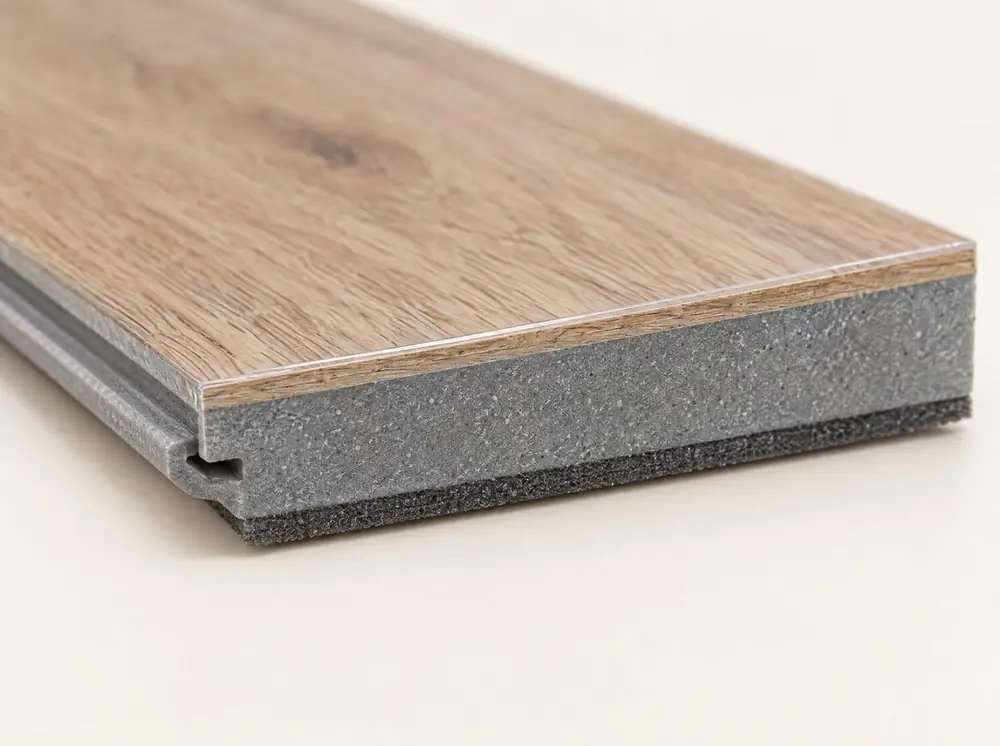 12
34
12
34
- Wear layer. Clear top coat that water beads on.
- Printed wood look. Sealed under the wear layer.
- SPC core. Stone plastic composite. It doesn’t absorb water.
- Attached pad. Part of the plank, not a separate sponge underneath.
A leak, a storm or a flood: the source changes the job
In Florida, water reaches the floor three ways. A plumbing leak inside the house. Rain through a roof or window in a storm. Or rising water from outside. We rebuild the floor after any of them, once the house is dry. What came in, and how long it sat, decides what has to happen first.
- Clean water from a supply line. A burst hose, a water heater or a dishwasher line is the simplest case. Once the area is dried, the slab is checked and the floor can be rebuilt.
- Dirty water or sewage. The EPA says damage from sewage or other contaminated water calls for a professional who has experience cleaning buildings after that kind of water. That cleanup comes before any new floor.
- Mold that spread. For mold covering more than about 10 square feet, the EPA points owners to its professional remediation guidance. That’s a remediation job, not a flooring job.
- Rising floodwater. The National Flood Insurance Program says most homeowners insurance does not cover flood damage. A flood policy is separate. Know which policy applies before you plan the new floor.
Floating or Glue-Down: The Trade-Offs Side by Side
Both methods use a waterproof plank. What changes is how the floor behaves when water gets underneath, and what it asks of your slab.
| Floating click-lock | Glue-down on concrete | |
|---|---|---|
| How it’s held | Planks lock to each other and rest on the slab | Each plank is bonded to the slab with adhesive |
| FEMA flood rating | Not rated as flood damage-resistant | Vinyl set in chemical-set adhesive on concrete is rated acceptable |
| After a small leak | Planks can be unclicked so the slab underneath can dry | Planks stay put, but can’t be lifted to air out the slab |
| Cabinets and islands on top | Makers don’t allow it; that area gets glued | Fine |
| Which planks work | The usual method for rigid core plank | Only planks whose maker approves glue-down |
| What it asks of the slab | Flat within the maker’s limit; one allows 3/16 inch in 10 feet | Clean, sound concrete the adhesive can bond to |
| Over old tile | Sometimes, if the tile is flat and solid | For the FEMA rating, the tile comes up so the adhesive meets the slab |
FEMA’s rating means the material can take at least 72 hours of direct contact with floodwater and need only cosmetic repair, like cleaning. It applies to glue-down vinyl on concrete only. The bulletin notes the same vinyl over a plywood floor isn’t rated, because it has to come up for the wood to dry.
Where Water Damage Shows Up, and What Each Room Needs
Most leaks start next to an appliance or a fixture. The rebuild looks a little different in each spot.
Washer hoses, water heaters
Often one contained room. The washer and dryer come out, the floor goes in, and they go back on a floor that won’t swell next time.
Sink, dishwasher, icemaker line
Water runs under the cabinets, where nobody sees it. The installer looks at how far it went and where the new floor meets the cabinet bases.
Toilets, tubs, supply valves
Water often reaches the hallway or the bedroom next door. The installer marks where the damage stops, so you know which rooms get new floor.
When water crossed several rooms, running one plank through all of them avoids a line where old floor meets new. See kitchen, bath and laundry floors
Before we rebuild the floor
After a leak, the house has been through enough. A short list keeps the rebuild simple.
- Get the drying sign-off in writing. If a mitigation company dried the house, ask for their final moisture readings.
- Fix the source. The leak has to be repaired, and the plumber done, before new floor goes down.
- Finish the walls first. Drywall patching and paint are a separate trade. Doing them before the floor keeps dust and drips off the new plank.
- Take photos and note the dates. When the leak started, when drying ended, and which rooms got wet. Your adjuster may ask.
- Clear the rooms. Anything that was stored on the wet floor, rugs and small furniture come out.
- Run the AC. Keep the house cool and dry in the days before the install, and after.
Read Before You Replace
What to know after a leak or a flood.
Water-Damaged Floor Questions
Do you remove standing water or dry out the house?
No. That’s the job of a water mitigation company. They extract the water, set up drying equipment and confirm when the structure is dry. We come in after that to replace the floor.
How soon after the leak can the new floor go in?
Once the slab is dry. Laying new flooring over a damp slab traps moisture and invites mold. If a mitigation company handled the drying, their sign-off is the best signal. We also check the slab before install.
Will my insurance pay for this?
That depends on your policy and your adjuster. We don’t handle claims. Your written estimate lists the rooms, square footage and work, and you can send it to your adjuster.
Can you match the floor in the rooms that didn’t get wet?
Sometimes. Older flooring is often discontinued. You can also run the new plank through the connected rooms so there’s no line where old meets new. The installer will show you both options.
Will vinyl plank survive the next leak?
The planks will. The SPC core doesn’t swell. What matters is not letting water sit underneath for days. Stop the leak, dry the area, and floating planks can be lifted if the slab needs air.
What if the damage is only in one room?
A single room, like a bathroom or laundry, is a common job. It’s often done in a day once materials arrive.
What’s the warranty on the new floor?
Installations come with our Limited Lifetime Warranty. It isn’t transferable to a later owner of the home. The flooring also carries the manufacturer’s warranty.
Does the slab need a moisture test before the new floor?
Yes. Plank makers set a moisture limit for concrete, often using ASTM F2170, a probe test that reads the humidity inside the slab, or ASTM F1869, a calcium chloride test. A slab that just dried on the surface can still be wet inside. The installer checks the slab at the measurement.
Should I go with glue-down if I’m in a flood zone?
It’s worth considering. FEMA’s flood materials bulletin rates vinyl glued to concrete with chemical-set adhesive as flood damage-resistant. Floating floors aren’t rated. You can look up your flood zone on FEMA’s Flood Map Service Center. The plank you pick has to be approved for glue-down.
Does homeowners insurance cover a flooded floor?
Often not. The National Flood Insurance Program says most homeowners insurance does not cover flood damage, which needs its own flood policy. A burst pipe inside the house is a different kind of claim. Your agent or adjuster can tell you which applies. We don’t handle claims.
Do you replace the drywall too?
No. Our job is the floor, the baseboard and the trim. Drywall and paint are a separate trade. Have them finished before install day so the new floor doesn’t get dust and paint on it.
Water-Damaged Floor Replacement Near You
533 ZIP codes across Tampa Bay, the Gulf Coast and Greater Orlando.
Other Jobs We Handle
Ready for a Floor That Can Take a Spill?
Book your free in-home measurement. Phones are answered 9:00 AM – 5:00 PM.